A research desk that makes one call.
Finance is the part of Forge where a team of 12 agents researches a US or Borsa Istanbul stock, argues both sides, sizes the risk and makes one call. Below is Finance itself, with a real NVDA analysis recorded on 29 July 2026: press Analyze NVDA to replay it, step by step.
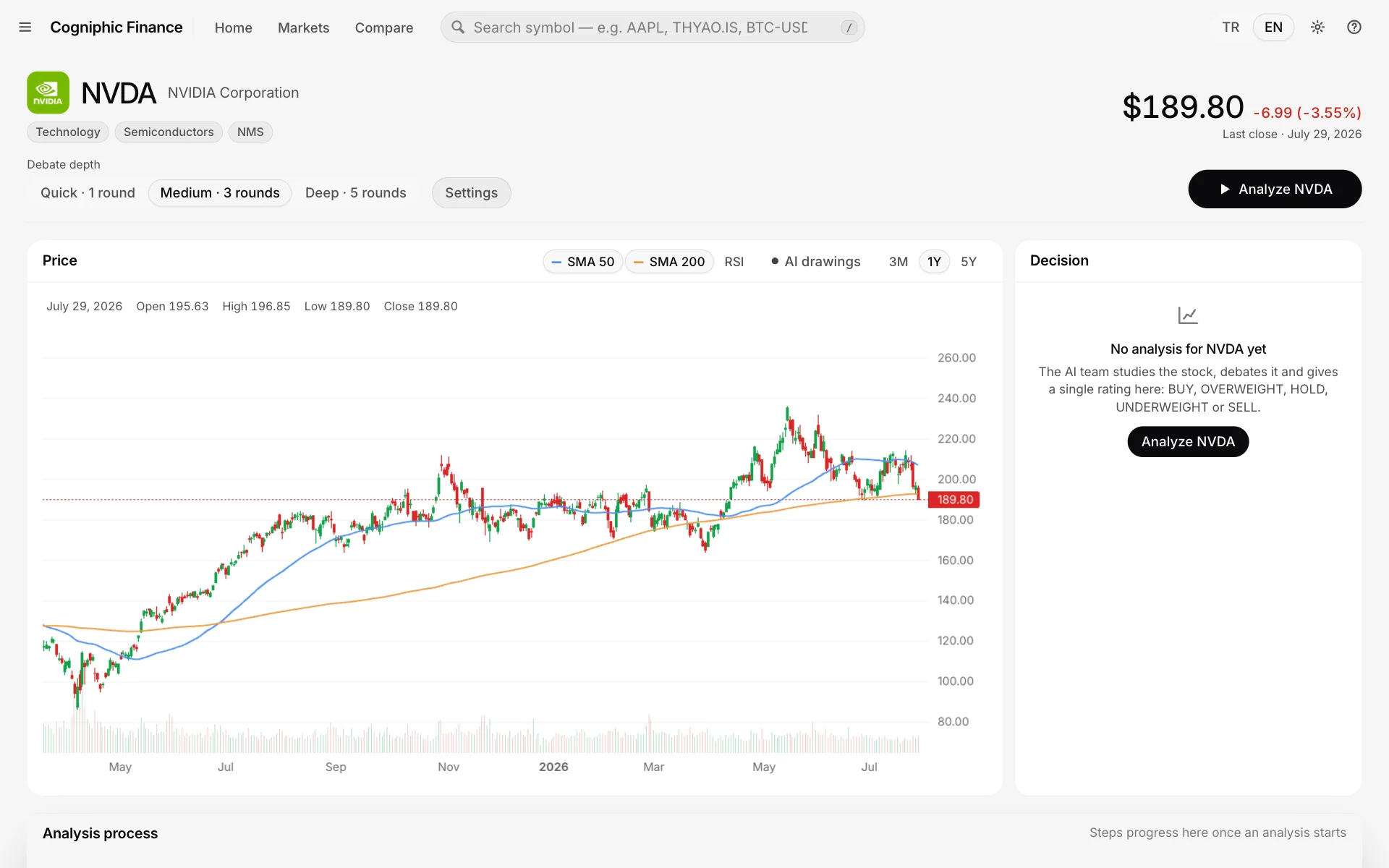
Finance. Press Analyze NVDA: the twelve agents replay the analysis of 29 July 2026, faster than real time.
The real Finance app replaying analyses recorded on their day, not live market data. Nothing here places a trade or sends data anywhere, and nothing here is investment advice. On a phone you see a screenshot.
- Team12 agents, seven stages
- JudgesClaude Opus 5.5
- CostAbout $1 an analysis
- TimeAbout 20 minutes
- Checked byMicrosoft Qlib
12 agents, seven stages, one call.
Each agent sees only what its job needs and writes one thing the next stage reads. Cheaper models do the reading and the arguing; Claude Opus 5.5 makes the two judgements that decide.
-
1
Data
No modelPrices and indicators from Yahoo; news from Finnhub, or KAP and the Turkish press; statements from SEC or KAP; macro from FRED or the Turkish central bank. Every source is cut at the analysis date.
-
2
Analysts
DeepSeek V4- Market
- News
- Fundamentals
- Sentiment live runs only
Each writes one report: trend and levels, what changed, the business in numbers, how retail opinion leans.
-
3
Debate
DeepSeek V4- Bull
- Bear
One argues for owning the stock, one against, each answering every point of the other. Three rounds each.
-
4
Research manager
Claude Opus 5.5Reads the whole debate twice, bear last and bull last. If the readings disagree, the rating moves toward Hold. Writes the plan.
-
5
Trader
DeepSeek V4Turns the plan into an order: buy, hold or sell, where to enter, where to stop, how much.
-
6
Risk team
DeepSeek V4- Aggressive
- Conservative
- Neutral
Argue the trade for three rounds: more upside, more protection, the balanced version.
-
7
Portfolio manager
Claude Opus 5.5Reads the plan, the trade, the risk debate and its own past calls on this stock, then makes the call with a thesis, a price target and a horizon.
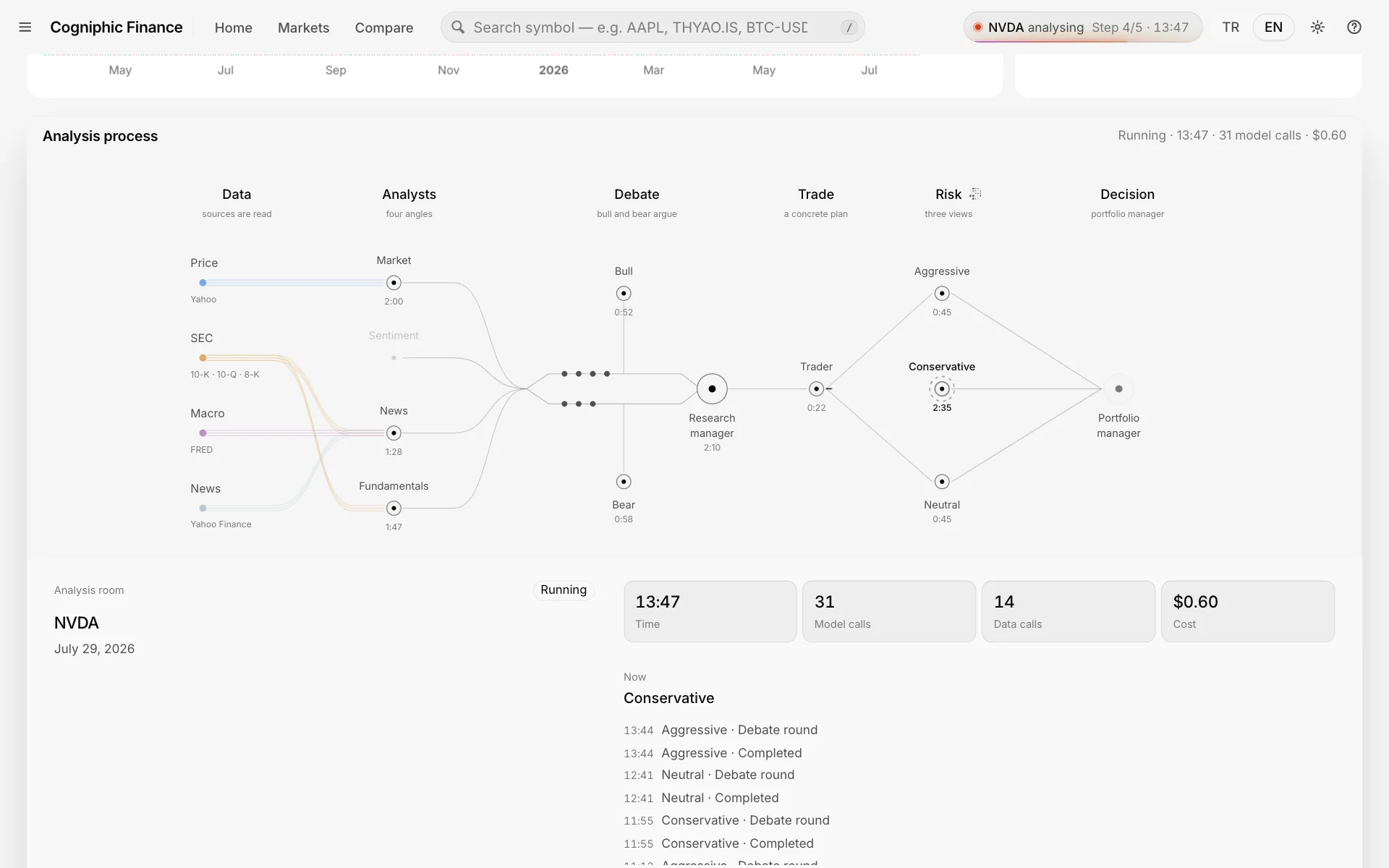
Bull against bear, then a judge who reads it twice.
A judge tends to side with whoever spoke last. So the research manager reads the debate once as it ended, with the bear last, and once after the bull gets a closing reply. If both readings agree, the rating stands; if not, it moves toward Hold.
From the recorded run · NVDA · 29 July 2026 · bull and bear on DeepSeek V4
Bull · opening“I see the chart. I see that $189.80 close. I see the breach of the 200-day SMA… That’s not NVIDIA’s earnings power eroding; that’s the market’s risk appetite temporarily contracting.”
Bear · reply“You ask what fundamentally changed between July 28 and July 29. That’s the wrong question. The right question is: why did NVDA decline 14.9% since the May earnings report that beat EPS estimates by 5.5%?”
Bear · third turn“I’m not short NVDA. I don’t need to be… Standing aside while the trend resolves is a position.”
Bull · closing reply“You said you’re not short. You said you’d buy the same company at a lower price. That’s not a bear. That’s a bull with a limit order.”
Research manager · Claude Opus 5.5 · the plan“The bull side wins on the business, but the bear wins on timing, so this is Overweight built in stages rather than a full Buy.”
It also corrected the winning side: “The bull’s numbers have errors: the latest quarter’s gross margin was about 59.4%, not 75%.”
Balance check Bear last: Overweight. Bull last: Overweight. Both orders agree; the direction holds.
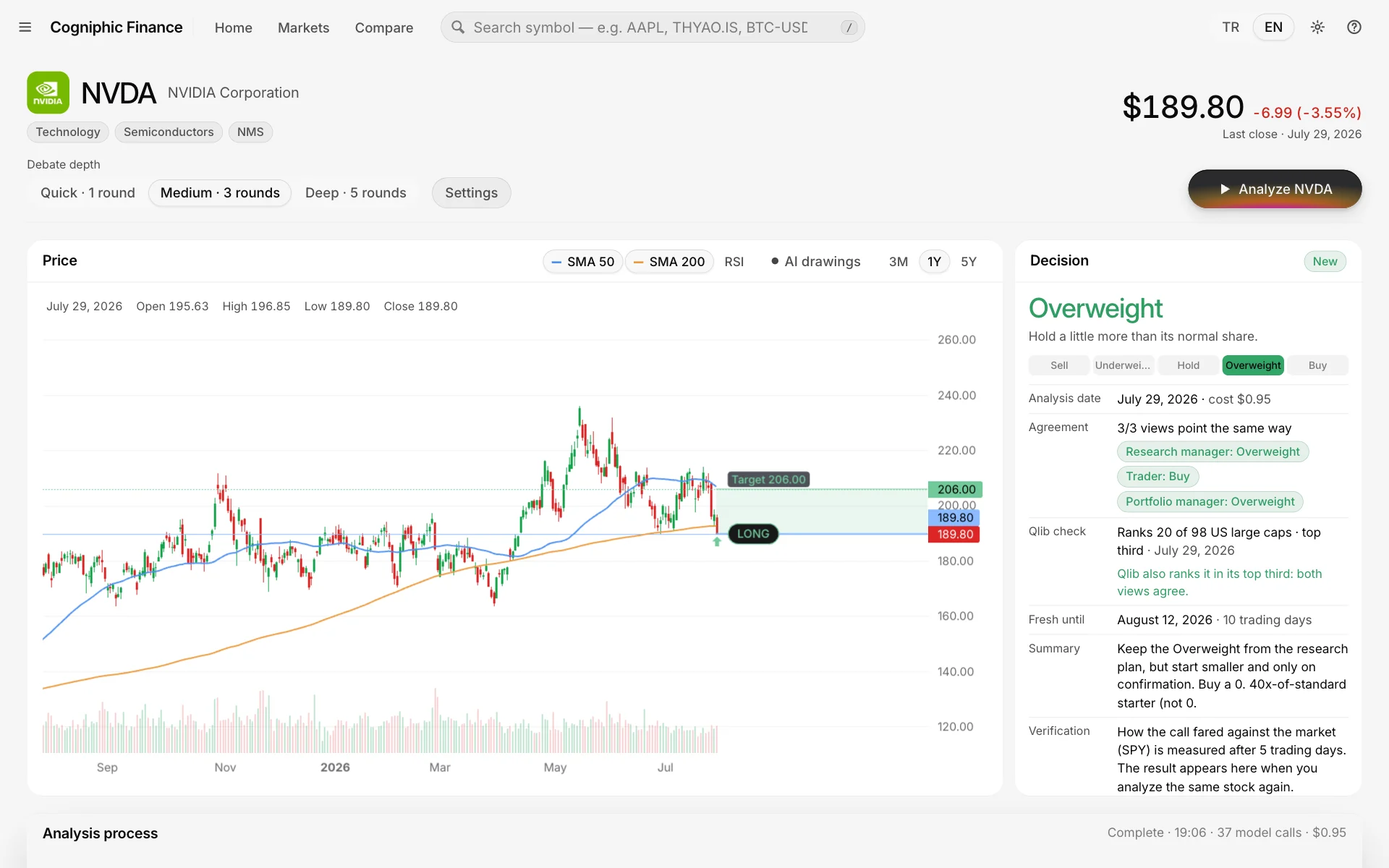
One call, on one card.
The portfolio manager’s rating comes out as a typed field on a five-step scale, with who agreed, what Qlib thinks and how long the call stays fresh. This is the card the recorded NVDA run produced.
- Agreement
- 3 of 3 views: research manager Overweight, trader Buy, portfolio manager Overweight
- Qlib check
- Ranks 20 of 98 US large caps, top third: both views agree
- Plan
- Start at 0.40× of a standard position, only on a close at or above $189.65; stop on a daily close below $182
- Target
- $206.00 from a $189.80 close · confidence 52%
- Fresh until
- 12 August 2026 · 10 trading days
- Run
- 19:06 · 37 model calls · 14 data calls · $0.95
The rating, plan, position size and price target come from a run recorded on 29 July 2026: illustrative, not a forecast and not investment advice.
Afterwards In the recorded outcome, NVDA closed 21 trading days later up 20.0%, 14.3 points ahead of the S&P 500. One call is not a record; the record is below. From a recorded run: illustrative, not a forecast and not investment advice.
Everything the team wrote, one tab each.
Summary, Ask the team, Final decision, Analyst reports, Debate, Trading plan, Risk review and Log: the full decision, the debate and every analyst’s report, as a page or a PDF. In the app, clicking any agent in the diagram opens what it wrote.
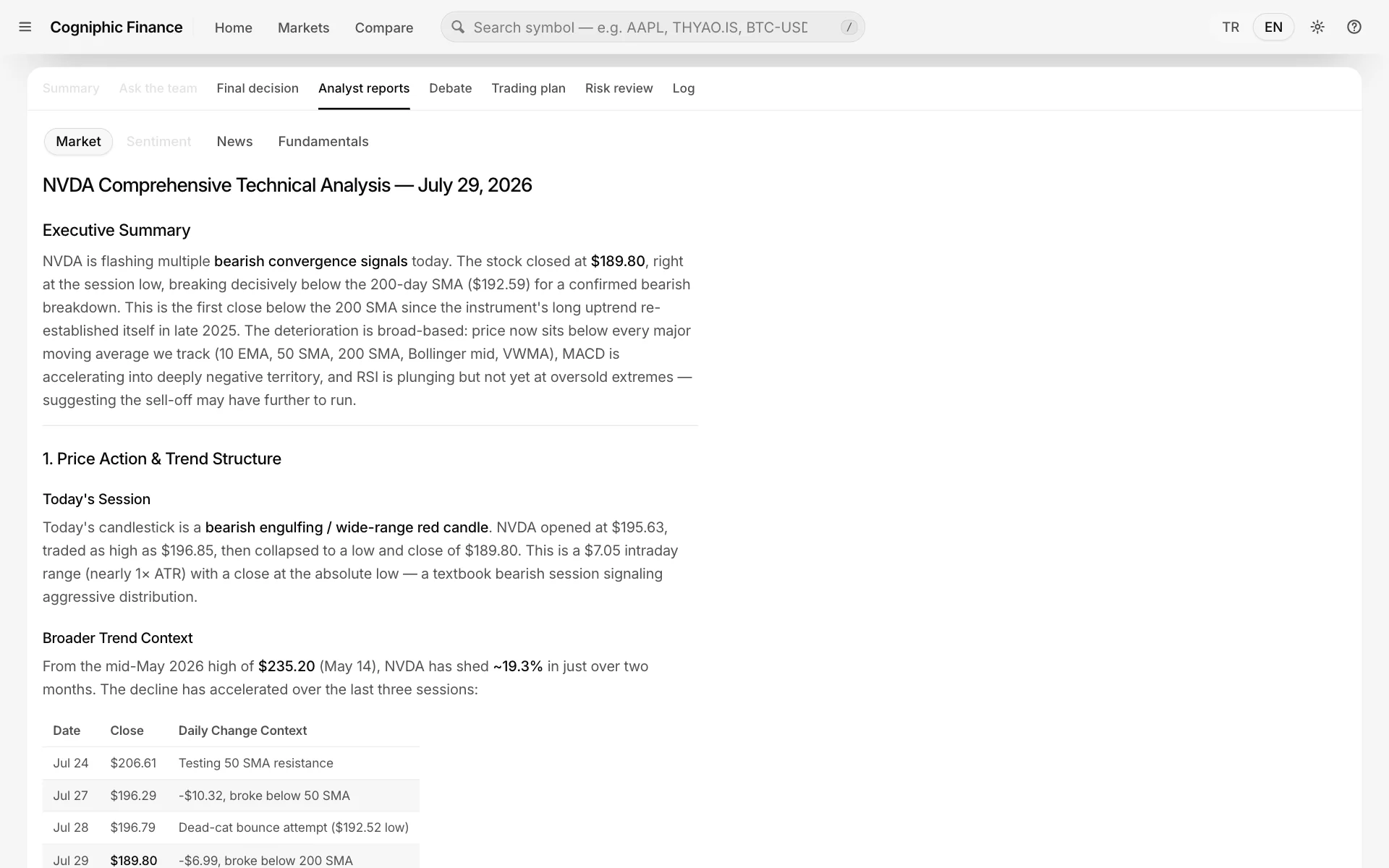
Analyst reports. Market, news and fundamentals, each a full report with its own indicators and tables. 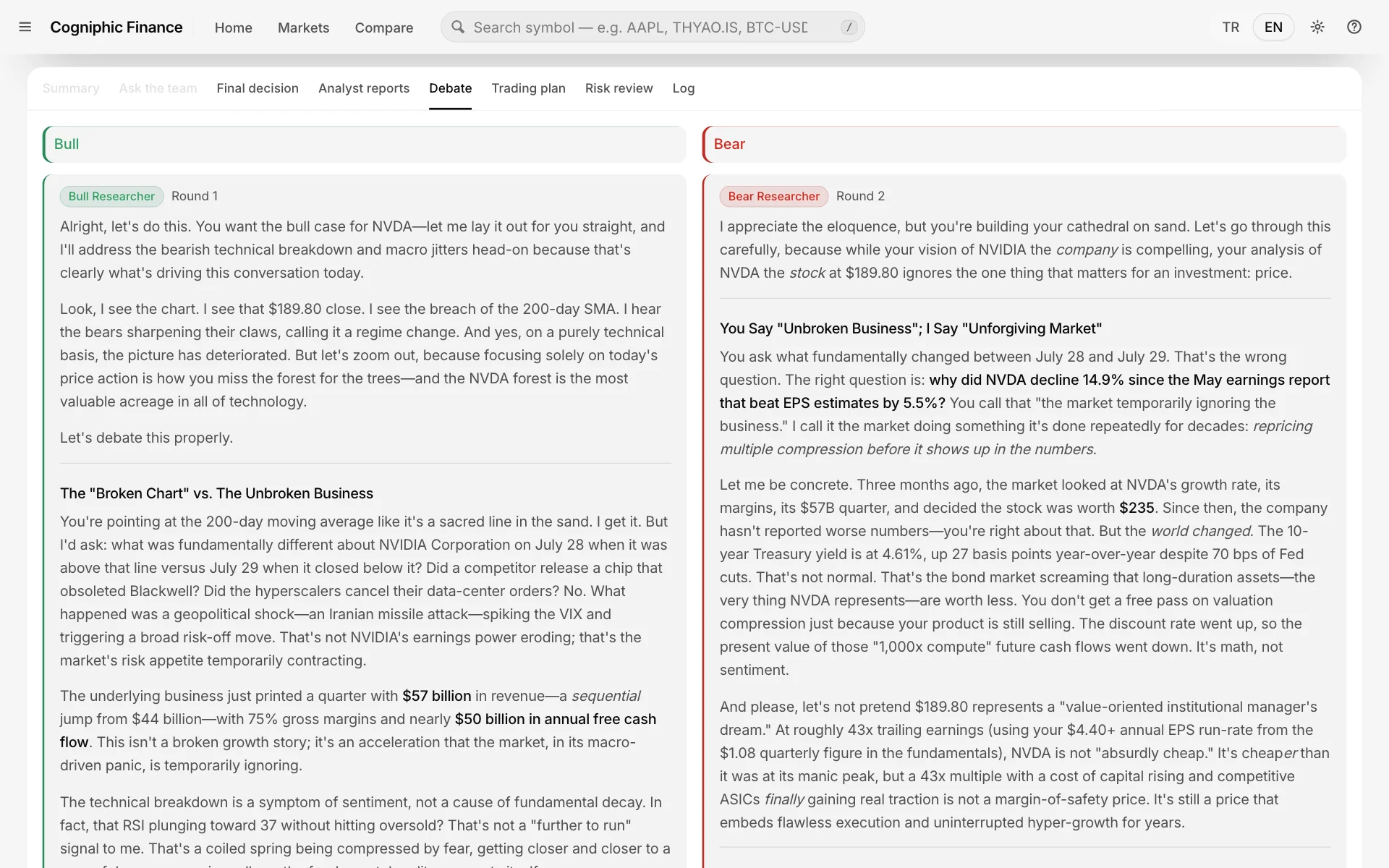
Debate. Bull and bear side by side, round by round, as they were written. 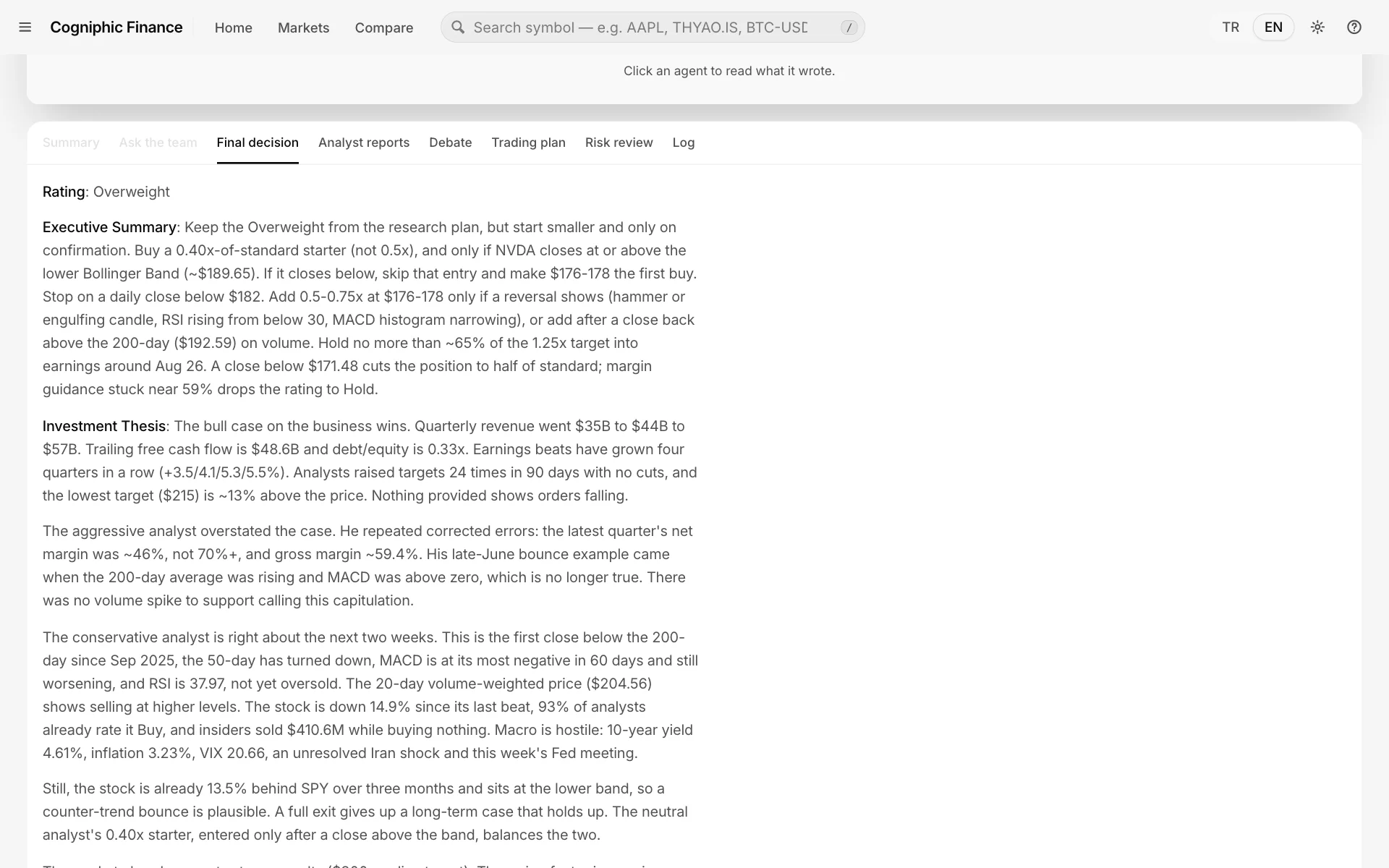
Final decision. The rating, the plan with its entry and stop, plus a thesis that says where each side was wrong.
What keeps it honest.
A research tool is only worth its record, and a record is only worth something if the tool could not peek. These are the rules built into every run.
- A
No look-ahead
Every tool returns only what was published by the analysis date. The backtests depend on it, and so does trusting a live call.
- B
Both speaking orders
The research manager judges the debate twice, bear last and bull last. A verdict that flips with the order is called balanced, not decided.
- C
Typed decisions
Ratings come out as structured fields, not parsed from prose, so a rating quoted inside the thesis can never replace the real one.
- D
A memory of its record
When a call’s horizon has passed, its result and a short reflection are written back. The next run on that stock reads them before deciding.
- E
What is priced in
In the US, the team also sees consensus targets, rating changes, earnings surprises and insider trades, each dated, and is asked to beat expectations, not describe a good company.
- F
A second opinion
Microsoft Qlib ranks the stock among its market every day. In Istanbul, where it helped in testing, a buy call Qlib ranks in its bottom third is flagged.
260 decisions, replayed in Qlib.
The team was given 26 stocks in two markets, the US and Borsa Istanbul, on 10 Wednesdays from 1 July to 2 September 2026, after its models’ training cutoff. Every decision was traded in Qlib with real costs. The question: does a book built from its calls beat simply holding the same stocks?
- 260Agent decisions backtested on 26 stocks in two markets.
- 276Backtests run in Qlib: models, rules, holding periods and markets, net of costs.
- 10 of 10Istanbul dates won by dropping the agents’ Underweights, against holding the same stocks.
- +6.9%The agents’ US book, against +2.6% for the S&P 500 over the same days, net of costs.
Figures on this page come from recorded runs and backtests of past decisions: illustrative, not a forecast and not investment advice.
| Book | Return | Sharpe | Max drawdown |
|---|---|---|---|
| BIST 100 index | — | — | |
| Same stocks, held equally | −0.57 | −9.5% | |
| Agents: Overweight only | −0.44 | −8.2% | |
| Agents: skip Underweight | +0.52 | −8.0% | |
| Qlib model: top half | +0.75 | −8.5% | |
| Agents + Qlib veto | +0.82 | −8.1% | |
| Agents + momentum veto | +1.41 | −8.0% |
| Market | Rating | Decisions | Avg return | Vs index | Right |
|---|---|---|---|---|---|
| US | Overweight | 88 | +1.8% | +0.2% | 48% |
| US | Hold | 38 | +3.6% | +2.4% | — |
| US | Underweight | 24 | +1.7% | +0.3% | 38% |
| Borsa Istanbul | Overweight | 36 | +1.4% | +5.4% | 61% |
| Borsa Istanbul | Hold | 27 | +4.8% | +7.7% | — |
| Borsa Istanbul | Underweight | 47 | −2.3% | −0.6% | 74% |
What the numbers say, and what changed in the app.
- +3.8 pts
In Istanbul, the calls carried real information.
Underweights went on to return −2.3% over 21 days and Overweights +1.4%: a gap of +3.8 points, with a 90% interval of +0.9 to +6.7. Dropping the Underweights beat holding the same stocks on 10 of 10 dates.
- +1.8 → +4.8
In the US, the book beat the index; telling winners apart was the weak part.
Most of the +6.9% came from owning strong large caps; the rule won on 4 of 10 dates. Given what the market already expects, the Overweight-minus-Underweight gap on the same 75 stock-dates grew from +1.8 to +4.8 points. Five dates are too few to call it proven.
- +7.0 → +13.4
Qlib is a good second opinion in Istanbul.
Against the same stocks: agents +7.0 points, with a Qlib veto +9.1, with a momentum veto +13.4. In the US, momentum lost on 9 of 10 dates, so there the app shows Qlib’s rank as context only.
- 10 days
Holding past two weeks added nothing.
In Istanbul, 10-day holds beat the same stocks by +9.6 points against +7.0 for 21-day holds. The app now marks a decision stale after 10 trading days and asks for a fresh one.
Method, written down first.
- Engine
- Microsoft Qlib 0.9.7: its data format, Alpha158 features, models, backtest executor and exchange.
- Prices
- Daily, adjusted, January 2014 to October 2026. 98 US large caps and 30 Istanbul large caps.
- Dates
- 10 Wednesdays, 1 July to 2 September 2026, after the models’ training cutoff.
- Trading
- At the next close, rebalanced daily, 5 bp a side in the US and 12 bp in Istanbul with its ±10% price limit.
- Fixed in advance
- Rules judged on July only; August and September kept back to test them.
What it does not show.
- Three months
- One quarter of decisions: a first reading, not a track record.
- Few stocks a day
- A few dozen stocks, not a whole market, so a book built from them is concentrated.
- Survivorship
- Qlib’s universes are today’s large caps, which favours the stocks that survived.
- Model drift
- The learned Qlib models lost their edge within a year or two of training.
- One currency each
- US results in dollars, Istanbul in lira, each against its own index.
About a dollar, about 20 minutes.
Of the 12 agents, 10 run on DeepSeek V4; the two managers that decide run on Claude Opus 5.5. That split is what keeps an analysis near a dollar. Qlib runs on the Mac at no cost.
The recorded NVDA run
- Time
- 19:06
- Model calls
- 37
- Data calls
- 14
- Cost
- $0.95
Runs on your Mac, inside Forge.
Pick a stock from the watchlist or search for one, choose how deep the debate goes and press the “Analyze” button. The chart, the decision and the team’s reasoning sit on one page.
- Runs on
- A local server on your Mac, opened inside Forge.
- Markets
- Prices for US stocks, Borsa Istanbul, Europe, China and crypto; analysis for US and Borsa Istanbul stocks.
- Languages
- English and Turkish, with English news for both markets.
- Engine
- The open-source TradingAgents framework, run unchanged, with the data sources, the balanced judge and the decision format around it.
- Keys
- Data-provider keys stay on your Mac. Model calls run on your Forge account or your own OpenRouter key.
Questions
Is this investment advice?
No. Finance is a research tool. It shows its reasoning and its record so you can judge it, including when it is wrong. Its calls can be wrong, as the record shows.
Does the demo show live prices?
No. It replays analyses recorded on their day, with that day’s prices: NVDA on 29 July 2026 by default.
Could the models have known these prices?
No. The backtested decisions are from July to September 2026, after the models’ training cutoff, and every data source was checked to return only what was published by the analysis date.
What is Qlib?
An open-source quantitative investment platform from Microsoft Research. Finance uses its data format, its Alpha158 feature set, its LightGBM and Ridge models and its backtest engine, which trades a signal day by day with costs and price limits.
Why not just use the Qlib model?
On its own it was unsteady: strong in Istanbul this summer, behind the same stocks in the US and stale within a year of training. The agents read filings, news and the debate; Qlib reads 12 years of prices. In Istanbul the two together did better than either alone.
Why judge on July and test on August–September?
So the rule to adopt is chosen before its test is seen. A rule that only looks good on the dates it was picked on is a fitted rule, not a finding.
What does an analysis cost?
About $0.90 in model costs with DeepSeek V4 for the team and Claude Opus 5.5 for the two managers, against $7 to $8 for an all-Opus team. The recorded NVDA run cost $0.95 and took 19 minutes.