Cogniphic builds intelligence at every layer, from the GPU that runs a model to the app you use it in. We publish what we measure, label what we illustrate, and write our decisions down before we build them.
7Divisions, one stack from the GPU to the product.
34Architecture decisions on record, each written before the code.
44kLines of Rust in the core.
868Benchmark runs on 371 tasks, every one public.
What we believe
Four rules we build by.
They decide what ships and what this site is allowed to say.
01
Show the work
A system people rely on should say what it read, what it ran, what it cost and what it changed. Ours do, and so does this site.
02
Measure, then claim
A number goes on a page only after it came out of a run we can show. The rest stays unsaid until it does.
03
Label what is illustrative
Where a figure is sample data or an estimate, it says so beside it, every time it appears.
04
Write decisions down
Architectural choices get a record before they get code: what we chose, what we turned down, and why.
The name
cogniphic
[cog·ni·phic] adjective
Drawn to intelligence; finding understanding beautiful.
Of a system: reasoning in the open, so that anyone can follow it, check it and build on it.
Divisions
Seven divisions, one stack.
Each division ships on its own and makes the others better: compute that serves research, research that shapes the runtime, and a runtime every product stands on.
From the repository’s history and its decision records.
2026-09-262026-10-17
The core
Platform decisions, a Rust core beside the desktop shell, safe IPC, the sandbox, the context engine and the verifier.
The first study
The engine against its own baseline: what a context engine and a prompt cache change, on tests neither agent saw.
Plugins and Studio
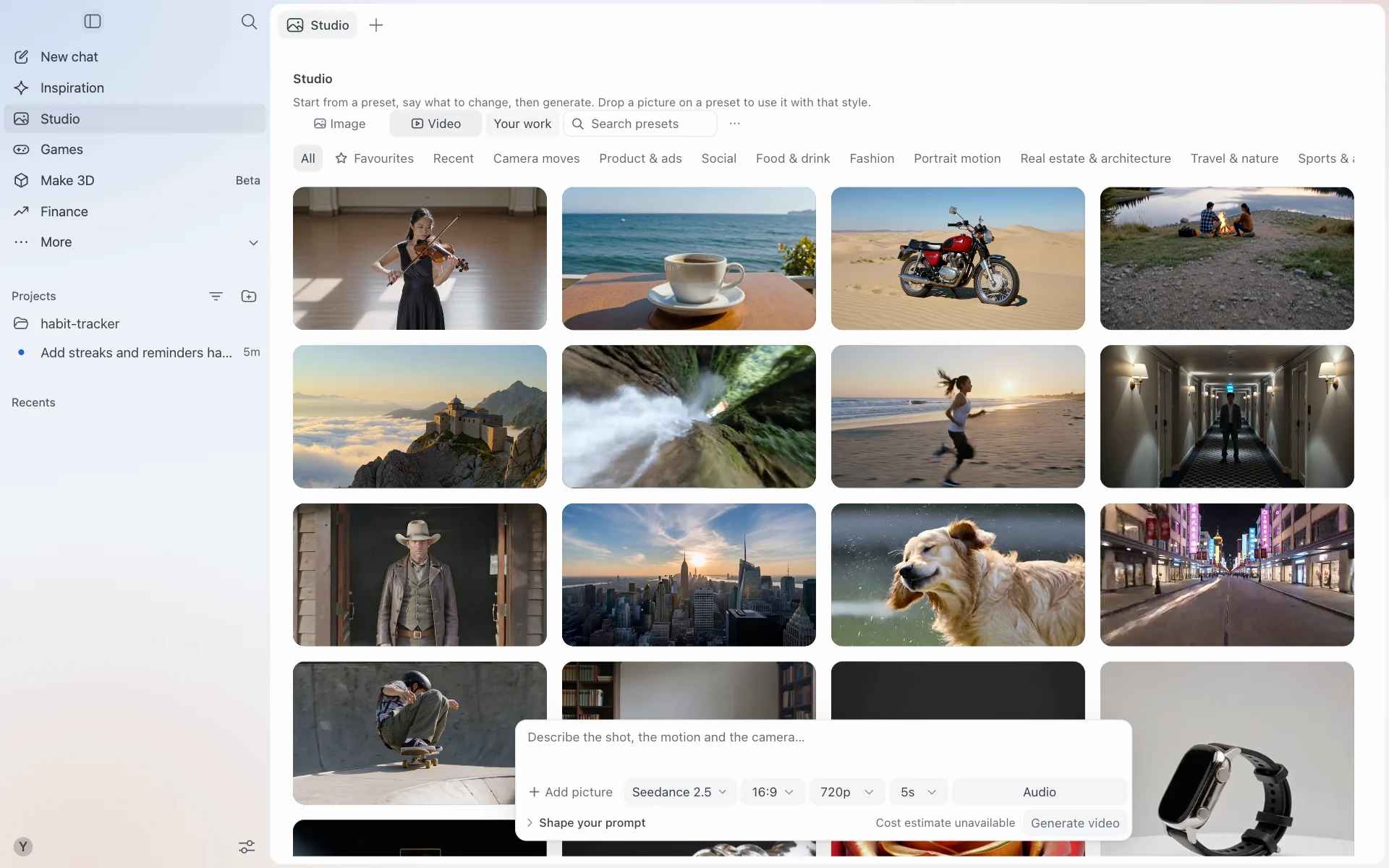
Remote MCP connectors behind approvals, and image and video generation in one panel.
Cloud
One sandbox account behind a gateway, for runs that need more than a Mac.
Games
A native Game Studio: describe a game, play it, keep every version.
Authorised testing
A pentest module with fixed tools that only touch targets you confirm.
The first public benchmark
Forge and Claude Code on the same model, on real GitHub issues from SWE-bench and on small tasks, judged by tests neither agent saw, with every run public. See the runs
How we work
Decided in writing. Proven in public.
Two habits make the rules hold: the decision is written before the code, and the run is published after it, failed runs and their cost included.
Decision records
34 on record
Written down before it was built.
Each record says what we chose, what we turned down, and why. A dozen of them:
0001Platform, toolchain and the process boundary
0005Sandbox, operation ledger and recovery
0009The Structural Context Engine
0010Provider cache and long conversations
0011Verifier, impact analysis and repair
0013Reliability, security and the P12 benchmark
0022Studio: image and video generation
0024Conversation threads, auto-apply and undo
0028The agent works in the project folder itself
0030Daytona as an optional cloud sandbox
0031Forge Cloud: one sandbox account behind a gateway
The same model, the same tests neither agent saw. Every run public.
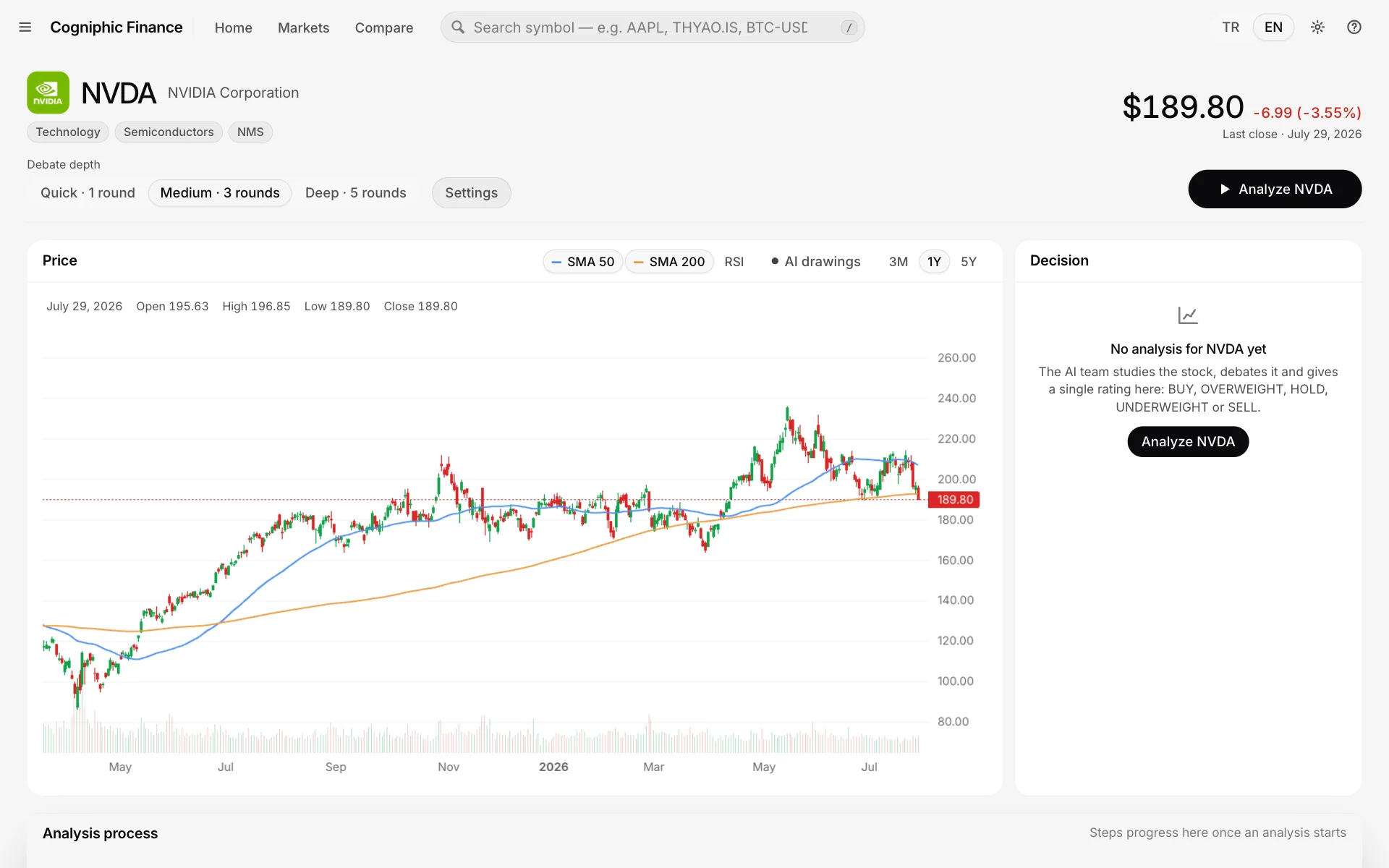
Forge runs against each agent on the model that agent’s maker built it for, so the difference is the agent. A task counts as solved only when tests the agent never saw pass on its result.
94.2%of Forge’s 434 runs on 371 tasks solved, against 92.6% for Claude Code’s 434, on the same model.
32%cheaper per solved GitHub issue than Claude Code: $0.159 against $0.234.
62%cheaper per solved small task: $0.043 against $0.113.
36%cheaper per solved issue than Codex on GPT-6 Astra, which solved 2 more of the 50.
Same model: Claude Opus 5.5
Forge and Claude Code, medium effort · 371 tasks, 434 runs each · official runs of 17 October 2026
ForgeClaude Code
Forge and Claude Code: every task set
Task set
Solved, by tests the agents never saw
Cost per solved task
For Forge
Large tasks · real GitHub issues in real repositories
All large tasksSWE-bench Lite outside the development sample, and 10 hard SWE-bench Verified issues
All large tasks: Forge solved 268 of 290, Claude Code 262. Cost per solved task: Forge $0.159, Claude Code $0.234.268/290 · 92.4%262/290 · 90.3%
$0.159$0.234
6 more solved32% cheaper
SWE-bench Lite, all 300the benchmark Aider reports on
SWE-bench Lite, all 300: Forge solved 276 of 300, Claude Code 273. Cost per solved task: Forge $0.150, Claude Code $0.223.276/300 · 92.0%273/300 · 91.0%
$0.150$0.223
3 more solved32% cheaper
SWE-bench Verified, hard10 of the hardest issues
SWE-bench Verified, hard: Forge solved 9 of 10, Claude Code 7. Cost per solved task: Forge $0.345, Claude Code $0.571.9/10 · 90.0%7/10 · 70.0%
$0.345$0.571
2 more solved39% cheaper
SWE-bench Lite, the other 260every issue outside the two samples
SWE-bench Lite, the other 260: Forge solved 239 of 260, Claude Code 237. Cost per solved task: Forge $0.153, Claude Code $0.222.239/260 · 91.9%237/260 · 91.1%
$0.153$0.222
2 more solved31% cheaper
Fresh sample20 issues drawn after Forge was built
Fresh sample: Forge solved 20 of 20, Claude Code 18. Cost per solved task: Forge $0.147, Claude Code $0.262.20/20 · 100.0%18/20 · 90.0%
$0.147$0.262
2 more solved44% cheaper
Fresh sample, never looked at14 issues nobody read before the run
Fresh sample, never looked at: Forge solved 14 of 14, Claude Code 12. Cost per solved task: Forge $0.147, Claude Code $0.266.14/14 · 100.0%12/14 · 85.7%
$0.147$0.266
2 more solved45% cheaper
Hard sample, never looked at4 hard issues nobody read before the run
Hard sample, never looked at: Forge solved 3 of 4, Claude Code 2. Cost per solved task: Forge $0.352, Claude Code $0.775.3/4 · 75.0%2/4 · 50.0%
$0.352$0.775
1 more solved55% cheaper
Development sample20 issues used while building Forge; not counted above
Development sample: Forge solved 17 of 20, Claude Code 18. Cost per solved task: Forge $0.121, Claude Code $0.200.17/20 · 85.0%18/20 · 90.0%
$0.121$0.200
1 fewer solved39% cheaper
Small tasks · programming exercises
All small tasksForge's own set and Aider's polyglot exercises, two runs each
All small tasks: Forge solved 124 of 124, Claude Code 122. Cost per solved task: Forge $0.043, Claude Code $0.113.124/124 · 100.0%122/124 · 98.4%
$0.043$0.113
2 more solved62% cheaper
Forge set20 tasks, two runs each
Forge set: Forge solved 40 of 40, Claude Code 40. Cost per solved task: Forge $0.035, Claude Code $0.096.40/40 · 100.0%40/40 · 100.0%
$0.035$0.096
Same score64% cheaper
Forge hard set8 tasks, two runs each
Forge hard set: Forge solved 16 of 16, Claude Code 16. Cost per solved task: Forge $0.047, Claude Code $0.120.16/16 · 100.0%16/16 · 100.0%
$0.047$0.120
Same score61% cheaper
Polyglot · Python34 exercises from Aider's benchmark, two runs each
Polyglot · Python: Forge solved 68 of 68, Claude Code 66. Cost per solved task: Forge $0.047, Claude Code $0.122.68/68 · 100.0%66/68 · 97.1%
$0.047$0.122
2 more solved61% cheaper
All tasksevery large and small task above, development sample included
All tasks: Forge solved 409 of 434, Claude Code 402. Cost per solved task: Forge $0.122, Claude Code $0.196.409/434 · 94.2%402/434 · 92.6%
$0.122$0.196
7 more solved38% cheaper
Every measure: confidence intervals, tokens, turns and time
Task set
Agent
Solved
Success (95% interval)
Cost per solved
Cost per run
Input tokens per run
Output tokens per run
Turns
Median seconds
All large tasks
Forge
268/290
92.4% (89–95%)
$0.1588
$0.1467
114,567
3,231
7.66
107
Claude Code
262/290
90.3% (86–93%)
$0.2337
$0.2111
240,781
2,990
8.50
36
SWE-bench Lite, all 300
Forge
276/300
92.0% (88–95%)
$0.1504
$0.1383
105,232
3,033
7.32
104
Claude Code
273/300
91.0% (87–94%)
$0.2228
$0.2027
230,651
2,827
8.22
35
SWE-bench Verified, hard
Forge
9/10
90.0% (60–98%)
$0.3454
$0.3109
298,239
7,209
13.60
132
Claude Code
7/10
70.0% (40–89%)
$0.5705
$0.3993
466,944
6,601
12.50
81
SWE-bench Lite, the other 260
Forge
239/260
91.9% (88–95%)
$0.1527
$0.1404
107,931
3,077
7.42
104
Claude Code
237/260
91.1% (87–94%)
$0.2216
$0.2020
229,691
2,808
8.32
35
Fresh sample
Forge
20/20
100.0% (84–100%)
$0.1469
$0.1469
109,001
3,243
7.80
122
Claude Code
18/20
90.0% (70–97%)
$0.2619
$0.2357
271,874
3,559
8.80
49
Fresh sample, never looked at
Forge
14/14
100.0% (78–100%)
$0.1471
$0.1471
107,208
3,294
8.14
117
Claude Code
12/14
85.7% (60–96%)
$0.2664
$0.2283
274,071
3,377
8.64
34
Hard sample, never looked at
Forge
3/4
75.0% (30–95%)
$0.3522
$0.2642
215,963
5,623
12.25
132
Claude Code
2/4
50.0% (15–85%)
$0.7751
$0.3875
425,359
6,089
8.75
98
Development sample
Forge
17/20
85.0% (64–95%)
$0.1209
$0.1028
66,386
2,248
5.50
98
Claude Code
18/20
90.0% (70–97%)
$0.1998
$0.1799
201,908
2,352
6.30
34
All small tasks
Forge
124/124
100.0% (97–100%)
$0.0430
$0.0430
18,336
1,282
2.73
21
Claude Code
122/124
98.4% (94–100%)
$0.1129
$0.1111
88,203
1,359
3.95
17
Forge set
Forge
40/40
100.0% (91–100%)
$0.0345
$0.0345
15,904
951
2.80
21
Claude Code
40/40
100.0% (91–100%)
$0.0956
$0.0956
86,758
1,073
4.35
13
Forge hard set
Forge
16/16
100.0% (81–100%)
$0.0473
$0.0473
24,017
1,421
4.00
34
Claude Code
16/16
100.0% (81–100%)
$0.1205
$0.1205
106,207
1,524
4.75
18
Polyglot · Python
Forge
68/68
100.0% (95–100%)
$0.0471
$0.0471
18,430
1,443
2.40
19
Claude Code
66/68
97.1% (90–99%)
$0.1216
$0.1180
84,817
1,488
3.53
17
All tasks
Forge
409/434
94.2% (92–96%)
$0.1221
$0.1151
84,852
2,629
6.15
79
Claude Code
402/434
92.6% (90–95%)
$0.1955
$0.1811
195,396
2,495
7.10
27
Same model: GPT-6 Astra
Forge and Codex through OpenRouter, medium effort · 50 GitHub issues and 124 small tasks
ForgeCodex
Forge and Codex: every task set
Task set
Solved, by tests the agents never saw
Cost per solved task
For Forge
Large tasks · real GitHub issues in real repositories
All 50 GitHub issuesthe fresh and hard samples, and 20 more issues of SWE-bench Lite
All 50 GitHub issues: Forge solved 35 of 50, Codex 37. Cost per solved task: Forge $0.609, Codex $0.958.35/50 · 70.0%37/50 · 74.0%
Every measure: confidence intervals, tokens, turns and time
Task set
Agent
Solved
Success (95% interval)
Cost per solved
Cost per run
Input tokens per run
Output tokens per run
Turns
Median seconds
All 50 GitHub issues
Forge
35/50
70.0% (56–81%)
$0.6092
$0.4265
146,856
1,684
9.74
103
Codex
37/50
74.0% (60–84%)
$0.9579
$0.7089
251,506
2,150
12.04
51
Fresh sample
Forge
16/20
80.0% (58–92%)
$0.4464
$0.3571
119,482
1,381
9.30
84
Codex
16/20
80.0% (58–92%)
$0.8172
$0.6538
229,983
1,919
11.65
50
SWE-bench Verified, hard
Forge
6/10
60.0% (31–83%)
$1.2341
$0.7405
267,309
3,207
13.00
110
Codex
6/10
60.0% (31–83%)
$1.6038
$0.9623
348,978
3,282
14.10
85
20 more of SWE-bench Lite
Forge
13/20
65.0% (43–82%)
$0.5212
$0.3388
114,005
1,224
8.55
104
Codex
15/20
75.0% (53–89%)
$0.8497
$0.6373
224,293
1,816
11.40
42
All small tasks
Forge
113/124
91.1% (85–95%)
$0.1307
$0.1191
25,493
1,269
6.69
37
Codex
114/124
91.9% (86–96%)
$0.3551
$0.3264
68,204
1,130
4.60
26
Forge set
Forge
40/40
100.0% (91–100%)
$0.0759
$0.0759
20,360
661
6.10
31
Codex
40/40
100.0% (91–100%)
$0.2948
$0.2948
68,711
693
5.17
19
Forge hard set
Forge
16/16
100.0% (81–100%)
$0.1165
$0.1165
29,847
1,144
7.69
43
Codex
16/16
100.0% (81–100%)
$0.3290
$0.3290
69,105
1,189
5.25
26
Polyglot · Python
Forge
57/68
83.8% (73–91%)
$0.1731
$0.1451
27,489
1,656
6.81
39
Codex
58/68
85.3% (75–92%)
$0.4039
$0.3445
67,694
1,373
4.12
29
Where Forge did not win. Claude Code finishes sooner: a median 36 s per GitHub issue against Forge’s 107 s. It solved one more issue of the development sample, and Codex solved two more of the 50 issues and one more small task. Cost counts every model call, repairs and failed runs included. One run per GitHub issue and two per small task, on one Mac; Forge’s cost is what OpenRouter charged, Claude Code’s is the cost it reports at list prices, and Codex was priced by us at OpenRouter list prices. How we measured
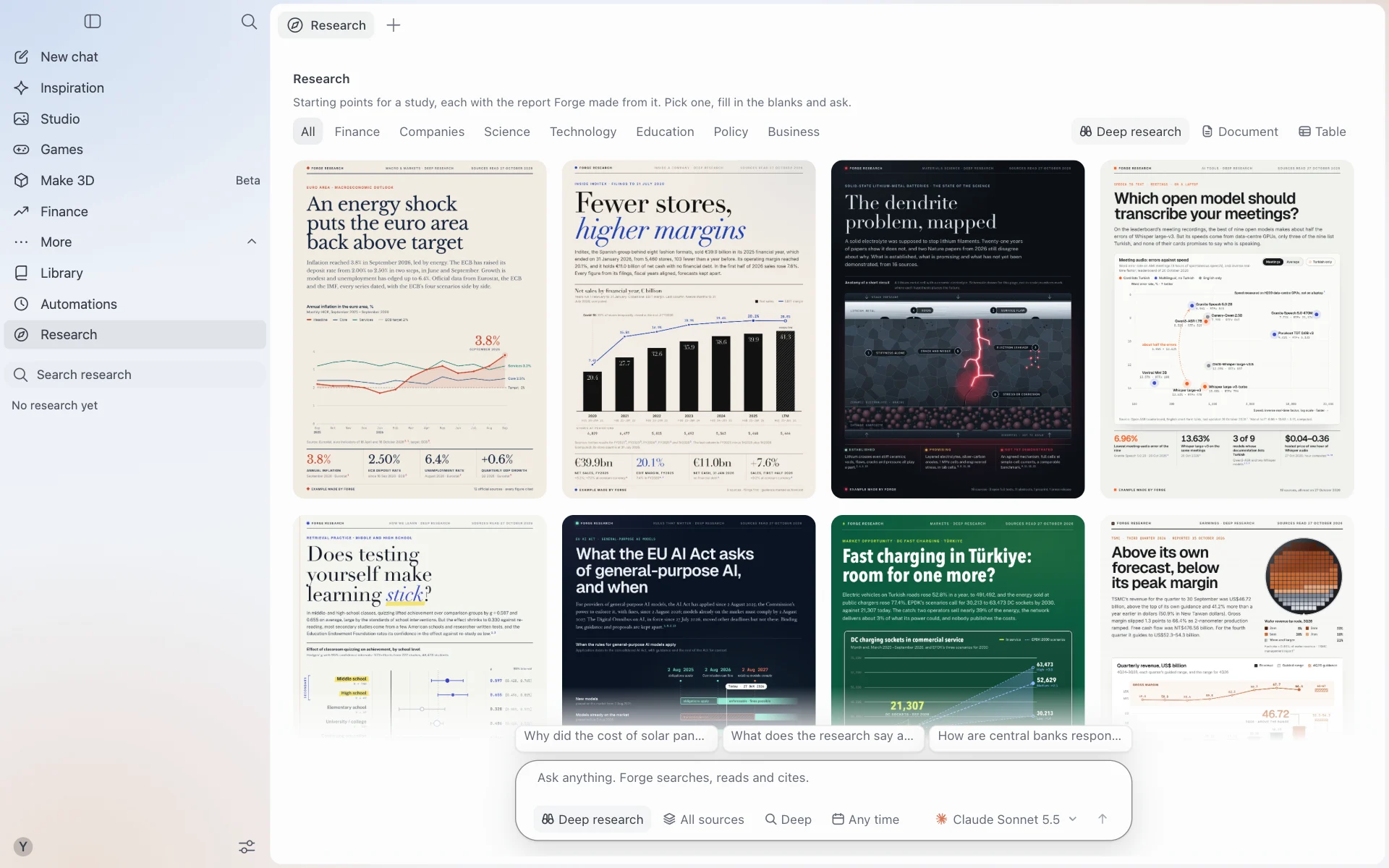
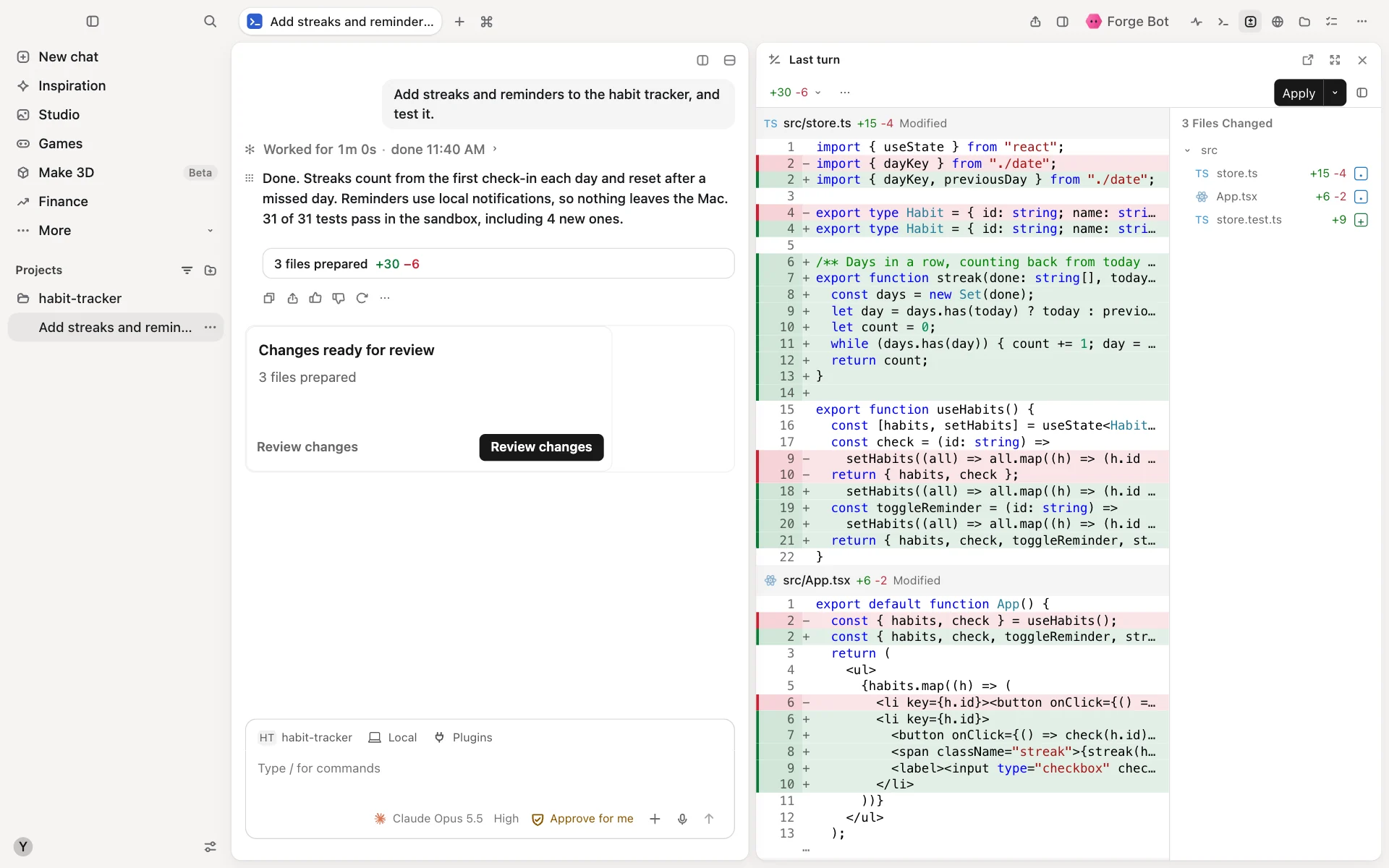
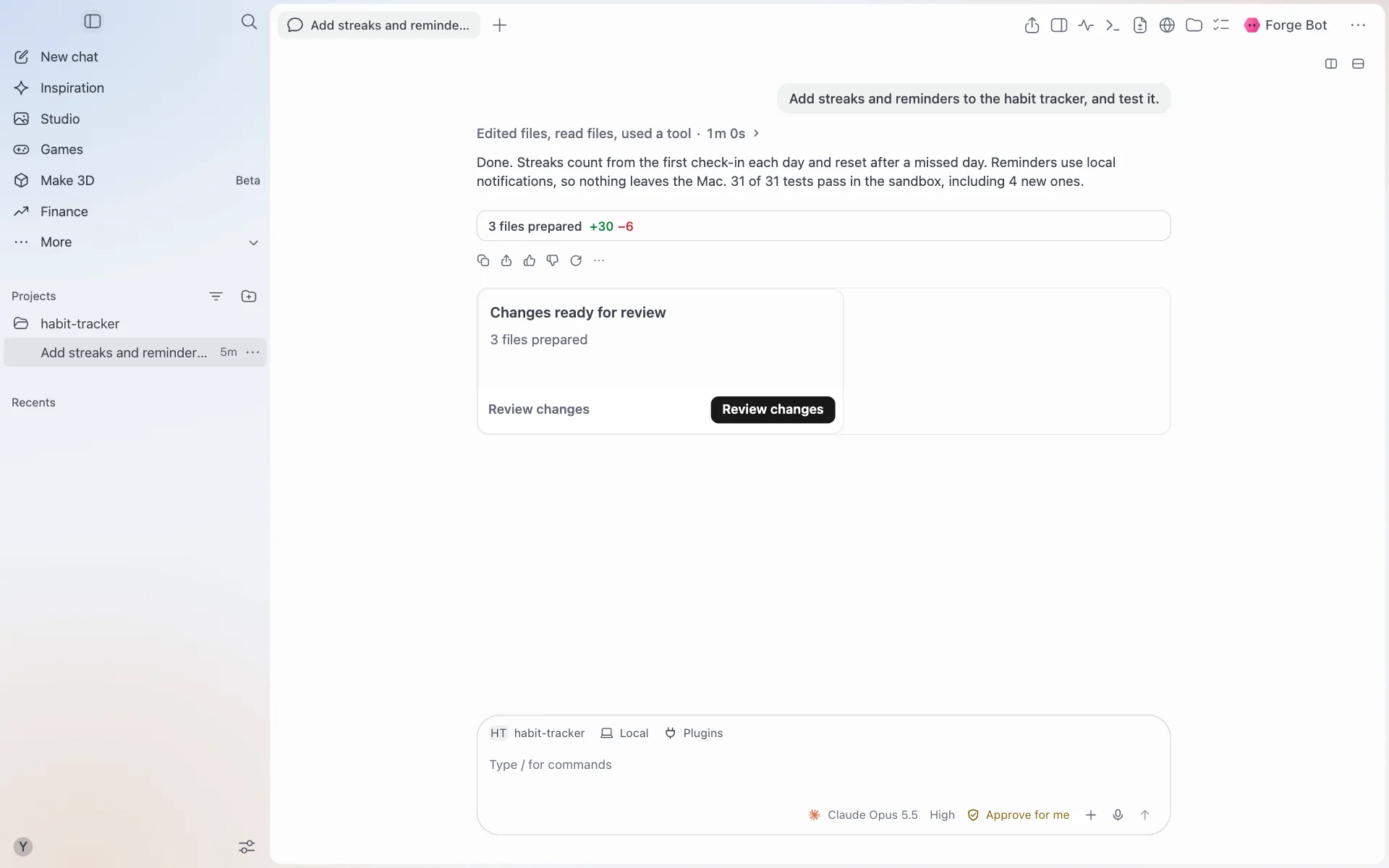
Build, Studio, Research, Games, Finance, Plugins and Automations, Forge’s seven workspaces, reach you in one Mac app. Afterburn, from the Compute division, runs at its own site.
ForgeMac app
Your whole AI team in one Mac app.
The newest models from every major lab, every change tested.
An AI lab with seven divisions: Compute, Research, Runtime, Studio, Finance, Forge and Security. Each ships on its own; together they run from the GPU to the product. The company is Cogniphic LLC, based in Istanbul.
What can I use today?
Forge, our Mac app, is ready to download. Afterburn, from the Compute division, runs at its own site: connect an endpoint, benchmark it and route on the results.
Are the numbers real?
Benchmark figures come from recorded runs, every one public in our benchmark repository with the harness that produced it. Afterburn panels on this site are sample data, labelled where they appear; in its console, every number comes from your own requests.
How is security handled?
Commands run in a sandbox with no network, tools that may change your data ask first, keys stay in the macOS Keychain (apps you connect through Composio keep their token with Composio), and every decision is written to a ledger you can read.
Check our work
Don’t take our word for it. Check the work.
Read the decisions before the code, open every benchmark run, or give Forge a task and see the tests it ran before it shows you the change.