Afterburn
Measure every endpoint. Route on the evidence.
Explore Afterburn
One OpenAI-compatible URL over the endpoints you already run.
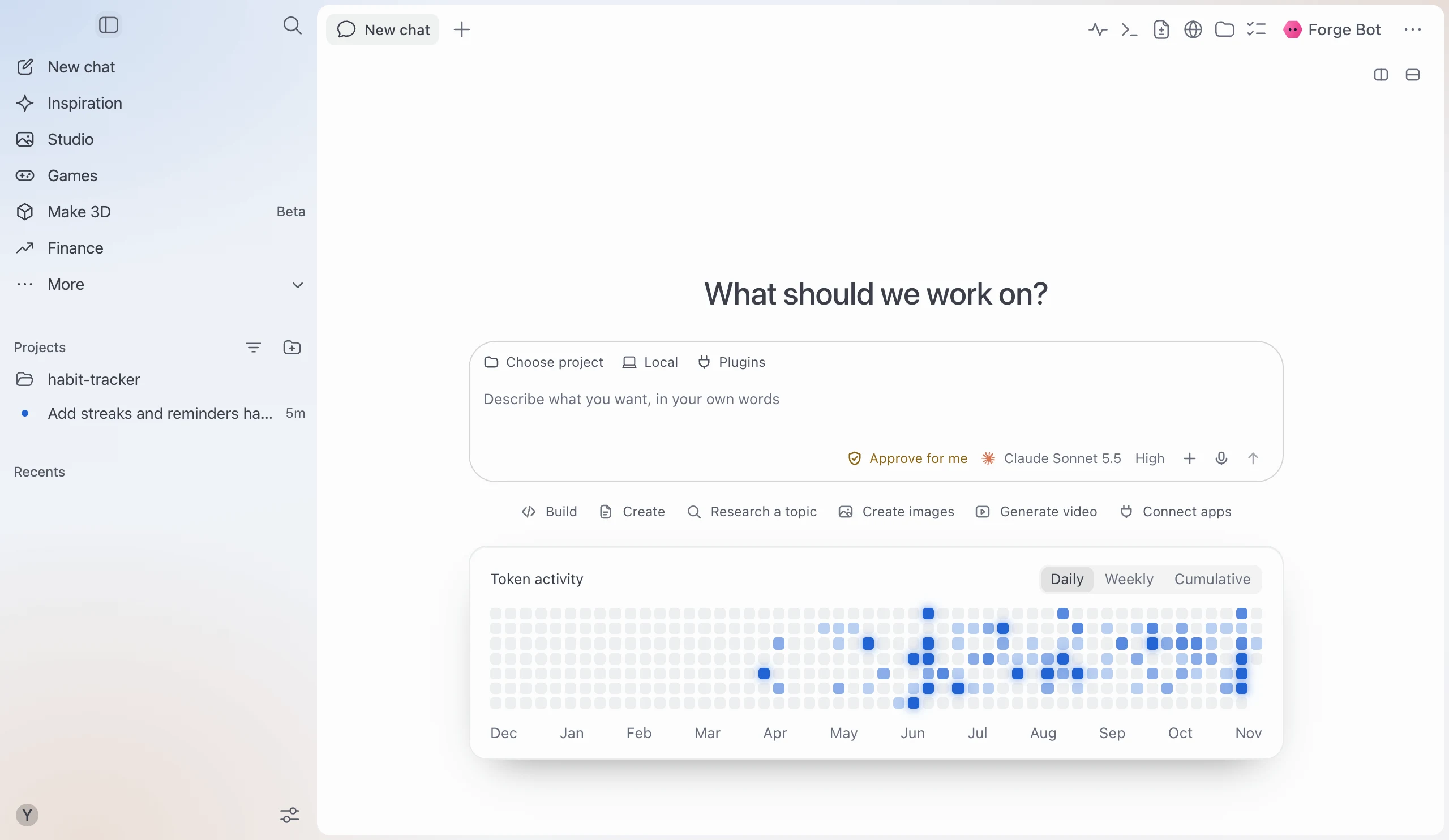
Describe a change; it writes the code, runs the tests and prepares every file for your review.
The real Forge app, running in your browser with demo data. It runs no model and sends nothing you type anywhere.
 GitHub
 Slack
 Linear
 Notion
 Figma
 Vercel
 Supabase
 Stripe
 Gmail
Work happens in a sandbox and comes back as a diff for every file. Nothing is applied until you say so, and you can undo it later.
It reads the project and writes the change. 3 files, +30 −6.
In a sandbox with no network and a read-only system.
Tests decide, not the model. 31 of 31 passed, 4 of them new.
You get the change and the evidence. You apply it, or you don’t.
The same steps on every task. The figures above come from a sample session and are illustrative.
868 official runs on 371 tasks, with Claude Opus 5.5 in both agents.
Cost per solved issue, against Claude Code on Claude Opus 5.5.
Input tokens per run.
Issues solved. Claude Code: 262 ÷ 290.
Slower. Median time per task; the line we lose.
Results of 17 October 2026
92.4%90.3%
$0.159$0.234
92.0%91.0%
$0.150$0.223
100%98.4%
$0.043$0.113
70.0%74.0%
$0.609$0.958
91.1%91.9%
$0.131$0.355
Accepted by tests neither agent saw: the share of runs, with its 95% interval. Cost per solved task: every model call, repairs and failed runs included. Lower cost is better.
| Study | Model | Agent | Accepted | Success (95% interval) | Cost per solved task |
|---|---|---|---|---|---|
| 290 GitHub issues | Claude Opus 5.5 | Forge | 268/290 | 92.4% (89–95%) | $0.159 |
| 290 GitHub issues | Claude Opus 5.5 | Claude Code | 262/290 | 90.3% (86–93%) | $0.234 |
| SWE-bench Lite, all 300 | Claude Opus 5.5 | Forge | 276/300 | 92.0% (88–95%) | $0.150 |
| SWE-bench Lite, all 300 | Claude Opus 5.5 | Claude Code | 273/300 | 91.0% (87–94%) | $0.223 |
| 124 small-task runs | Claude Opus 5.5 | Forge | 124/124 | 100% (97–100%) | $0.043 |
| 124 small-task runs | Claude Opus 5.5 | Claude Code | 122/124 | 98.4% (94–100%) | $0.113 |
| 50 GitHub issues | GPT-6 Astra | Forge | 35/50 | 70.0% (56–81%) | $0.609 |
| 50 GitHub issues | GPT-6 Astra | Codex | 37/50 | 74.0% (60–84%) | $0.958 |
| 124 small-task runs | GPT-6 Astra | Forge | 113/124 | 91.1% (85–95%) | $0.131 |
| 124 small-task runs | GPT-6 Astra | Codex | 114/124 | 91.9% (86–96%) | $0.355 |
Afterburn sits in front of the endpoints you already run. Apps call one OpenAI-compatible URL and name a route as the model; each request goes to the endpoint that keeps its latency limit for the least cost.
from openai import OpenAI
import os

client = OpenAI(
    base_url=os.environ["AFTERBURN_URL"],
    api_key=os.environ["AFTERBURN_KEY"],
)
reply = client.chat.completions.create(
    model="support-chat",  # a route, not an endpoint
    messages=[{"role": "user", "content": "Where is my order?"}],
)
print(reply.choices[0].message.content)
import OpenAI from "openai";
const client = new OpenAI({
baseURL: process.env.AFTERBURN_URL,
apiKey: process.env.AFTERBURN_KEY,
});
const reply = await client.chat.completions.create({
model: "support-chat", // a route, not an endpoint
messages: [{ role: "user", content: "Where is my order?" }],
});
console.log(reply.choices[0].message.content);curl "$AFTERBURN_URL/chat/completions" \
-H "Authorization: Bearer $AFTERBURN_KEY" \
-H "Content-Type: application/json" \
-d '{"model": "support-chat",
"messages": [{"role": "user", "content": "Where is my order?"}]}'Each division ships on its own and makes the others better.
Measure every endpoint. Route on the evidence.
Explore AfterburnIt reads your code before the model does. Seven steps, one engine.
Explore RuntimeSandboxes, approvals, keys and a record of every decision, in every layer.
How security worksEvery claim measured, with the logs kept.
See every studyEverything here was written by Forge and runs in your browser.
A recorded result: no model runs on this page.
Forge for building, Afterburn for the teams running inference.
Your whole AI team in one app.
One OpenAI-compatible URL over the endpoints you already run.
Twenty image and video models in one panel, the price before every take, and one timeline.
Explore StudioTwelve agents argue both sides of a stock and make one call. A research tool, not investment advice.
Explore FinanceQuestions in, sourced reports out. Every citation is checked against the passage it rests on.
Explore ResearchSeven divisions in Istanbul. We publish what we measure and write decisions down first.
About Cogniphiccog · ni · phic adjectiveDrawn to intelligence; finding understanding beautiful. Of a system: reasoning in the open, so that anyone can follow it, check it and build on it.